Learn how the function executed in JavaScript.

What is Stack ?
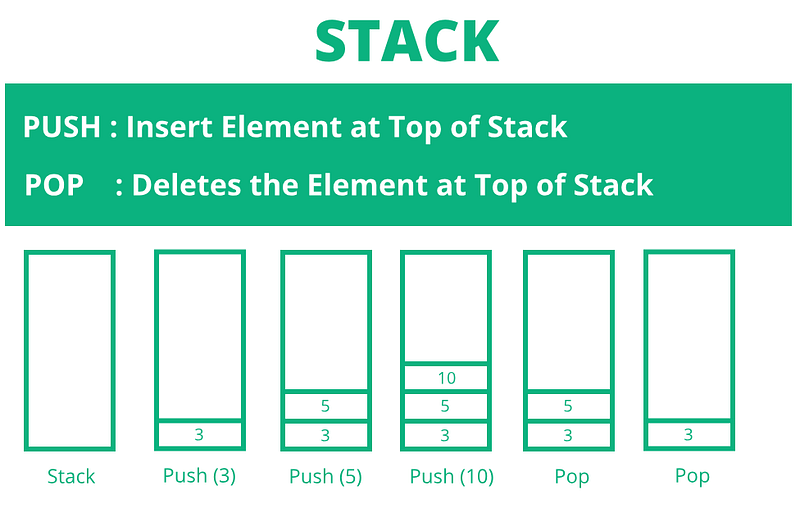
Stack is a Data structure, which is similar to an array, except that we cannot access the elements using the index directly and we can only insert and delete elements at the Top of Stack(ToS).
We majorly perform 2 operations in stack
-
Push→ Inserting an Element -
Pop→ Deleting an Element
Stack follows LIFO (Last In First Out) , means
- If stack encounter push operation then the element is
inserted at the Top of the Stack(ToS), - If stack encounters pop operation the
element at the Top of the Stack(ToS) is removed first.
In programming, the stack(call stack) is used to store the order of function call. So that we can store the latest function call at the top, once the function is executed, the last executed function can be removed from the stack.
JavaScript is Single thread , meaning JavaScript can handle(executes) only one function at a time, So for this case, only one stack is enough to handle.
Single Thread → One Stack → One function execution at a timeEVENT LOOP
The event loop is one which, checks if there is any function call in the call stack, and takes the function call and executes it.
function one() {
var a = 10;
 return a;
}
How the function will be executed internally
Let’s create a function,
function one() {
   var a = 10;
   return a;
}
When we call the function one ,
-
oneis pushed to the call stack , - Then it executes line
var a = 10;which is a variable creation so memory forais created inheap(this is where memory for variables, objects, and functions are allocated ) - Then the next line is executed
return a, this will return the value ofa. - Once the function is finished executing, then it is removed from the call stack.

Now let’s look into another Example
function one(){
 two();
}
function two() {
 three();
}
function three() {
 console.trace(“Call Stack”);
}
one();
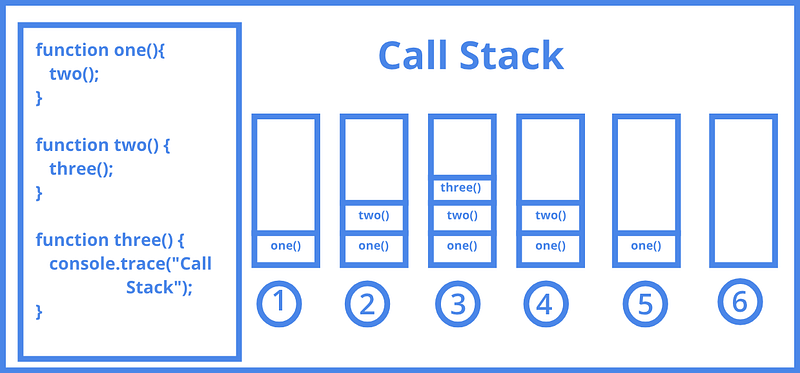
- When the function call for
one()is made, it is pushed to the call stack. - Inside the
onefunction another function call totwo()is made. So now thetwois pushed to the call stack, and the control is transferred to functiontwo. - Inside
twoanother function call tothree()is made. Sothreeis pushed to the call stack, and the control is transferred to functionthree. - The
console.tracein functionthreewill print the call stack, then there is no more statement to execute in functionthree, so, it will be removed from the call stack and the control go back to functiontwo. - In the function
two, there is no more statement to execute, sotwois removed from the call stack and the control transferred to the functionone. - In the function
onethere is no more statement to execute, now it also removed from the stack.
How many function call can be pushed to Stack.
The Stack is a data structure there will some certain amount of memory allocated to the call stack, So there is only a certain number of calls that can be pushed to the call stack. If the call stack is full then it will throw Maximum call stack size exceeded(StackOverflow) exception.
Learn about exceptions here.
To get Maximum call stack size exceeded, we can

var i =0;
function test() {
console.log(i++);
  test();
}
This will print the maximum number of calls we can push to the call stack of JavaScript.
Now let’s understand Async Function Execution.
Up to this, we learned that only one thing can be executed by JavaScript at a time, but not for async call.

Consider that we need to download a large image.
If JavaScript executes the downloadImage function and what if the internet is slow, then it blocks the page, everything will be frozen.
But JavaScript will handle this in another way using an asynchronous function.
An asynchronous function is a function which operates asynchronously via the event loop, using an implicit Promise to return its result.
In simple words, An asynchronous function is a function with two things, request and callback. callback function which will be executed once the response for the request is received.
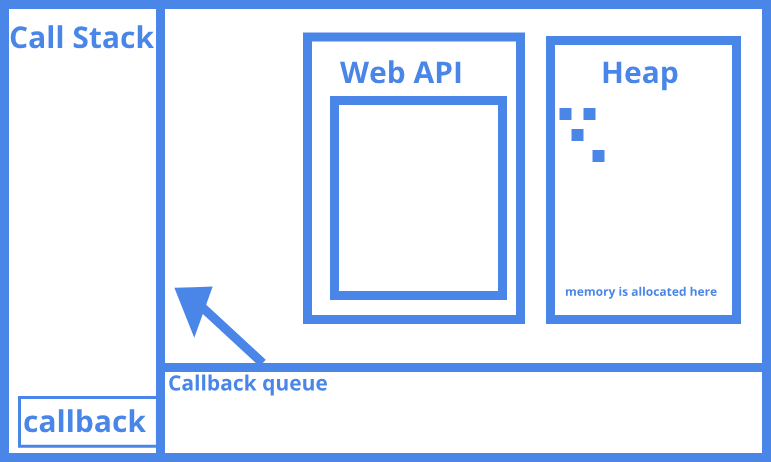
Once the asynchronous function is called it is pushed to the call stack and the call back is pushed to WEB API’s(provided by Browser) this will handle the success of request, and then the remaining part of the asynchronous is executed, then the function call is removed from the call stack.
Once the WEB API receives the success for a request then it will push the corresponding callback to the callback queue (this is where callback are pushed, in that order the callback will be pushed to call stack). When event loop finds that the call stack is free, the callback from the message queue will be pushed to the call stack and the callback will be executed as a normal function execution.

When it finds fetch call inside the
downloadImagefunction , it sends the request , then executes the next line of the function.
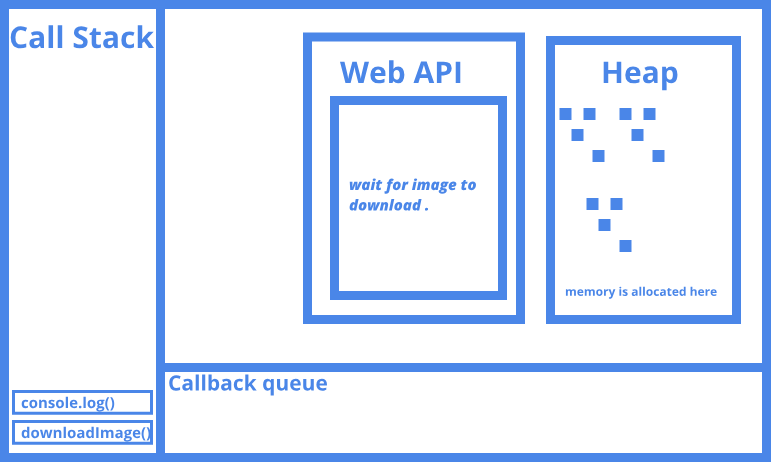
Once the image is downloaded the callback is pushed to callback/message queue
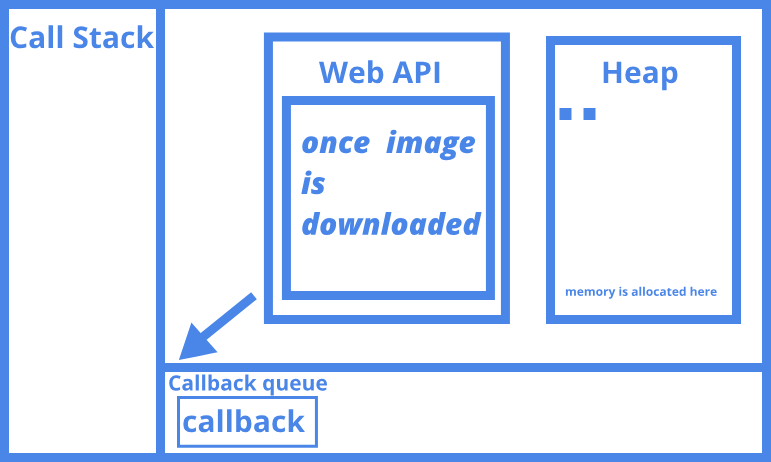
If there is no current function is executing(if the call stack is empty), then it is pushed to call stack and executes the callback
The above case works similarly in setTimeOut also.
Visual representation of the event loop can be found here.
References :
Thanks for Reading 📖 . I hope you like this. If you found any typo or mistake send me a private note 📝 thanks 🙏 😊 .
Follow me JavaScript Jeep🚙💨 .
 Js Jeep 🚙